Showing posts with label handwriting analysis. Show all posts

Saturday, October 15, 2016

tarot & handwriting: your writing slant

In my previous post, Tarot and Your Handwriting, I compared the symbolism of the four tarot suits to the four handwriting types. In this follow up post, we're examining writing slant and the tarot cards that might reflect this symbolism.

Slant is an important variable in handwriting. It reflects emotional expression and how the writer faces life situations. This is an observation of outer personality rather than inner personality so it shows how the writer will be perceived by others, not necessarily how they feel inside.

There are three basic slants in handwriting: vertical, left, and right. The vertical slant doesn’t lean forward or backward. Upstrokes and downstrokes are more or less straight. These writers demonstrate a head-over-heart attitude. They are open to the experience of the moment but keep their emotions under control.
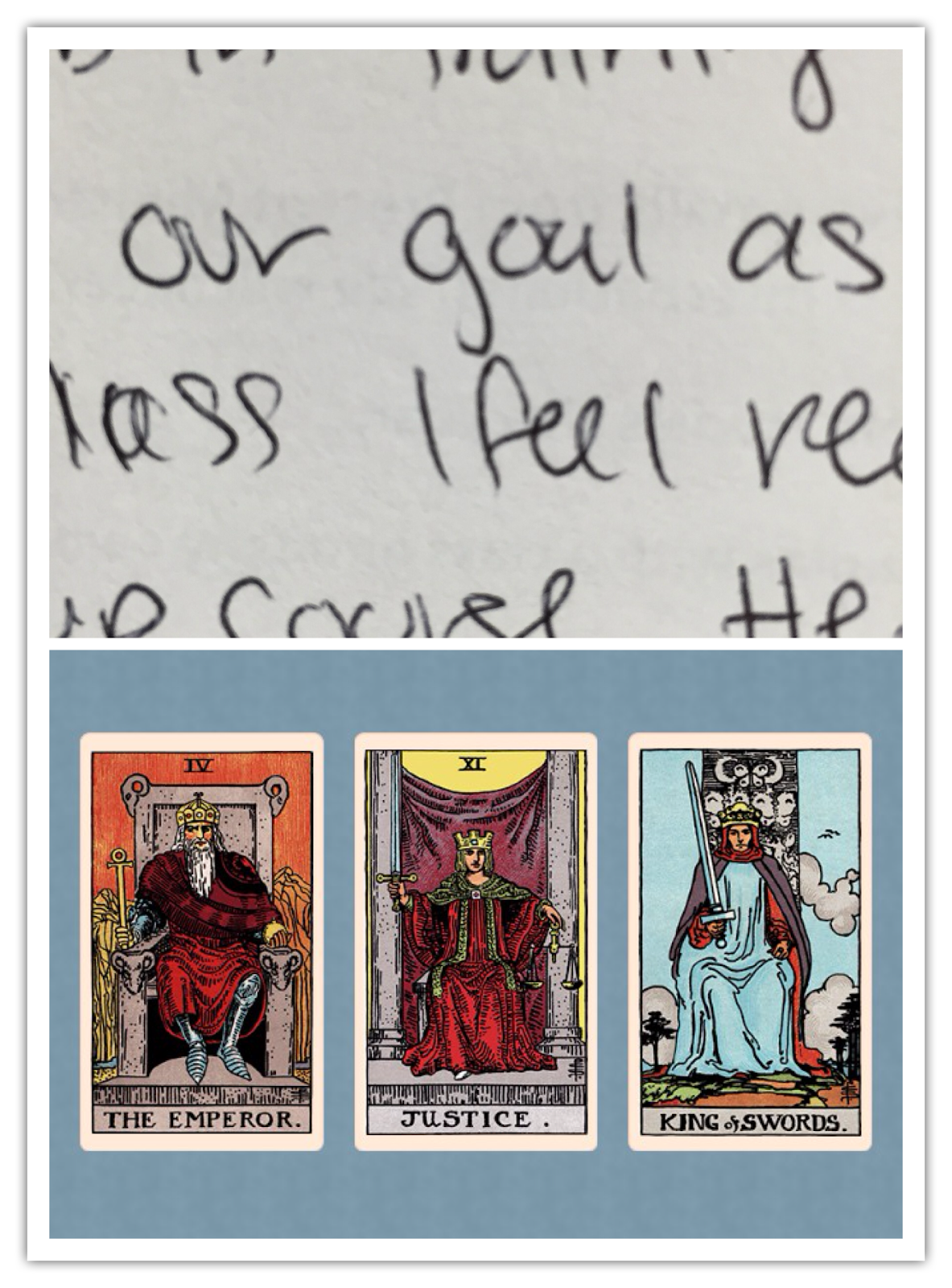

Photo Aug 24, 9 52 06 AM.png
 We can see this intellectual control depicted in cards like The Emperor, Justice, and the King of Swords whose characters face forward. When these cards appear in your readings, they are showing you there’s a need to take emotional control and get clarity and perspective on your situation.

In the left slant, the handwriting looks as if it’s reclined, leaning backward. These writers maintain even more emotional control, at least outwardly. However, they can be charming in social situations while still remaining emotionally aloof. What you’ll realize is that they never really share much of themselves in conversation. Nothing personal at least. It reflects a person who feels different from others.
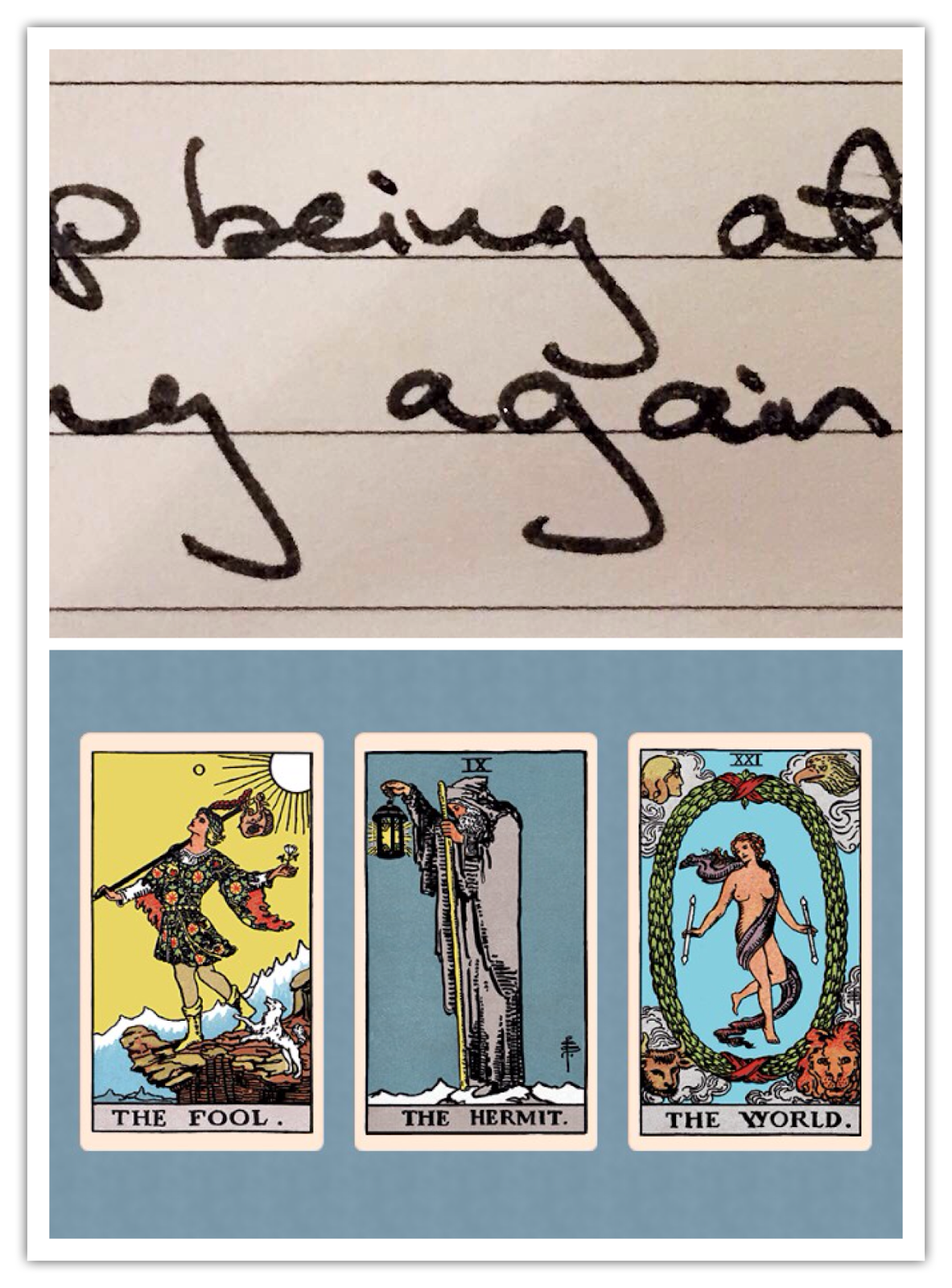

Photo Aug 24, 1 01 45 PM.png

We can see elements of aloofness and isolation in tarot cards like The Fool, The Hermit, and The World where the characters look and move toward the left. The Fool stands alone on a craggy hill, possibly about to take a leap. The Hermit secludes himself seeking knowledge and wisdom. The main character in The World lives in her own little bubble which is usually illustrated as a wreath encircling her. 

Finally, the right slant looks as if it’s racing forward toward something. This slant is all about emotional expression and the farther right it leans, the more outwardly expressive the person is. This writer is who the phrase “TMI” (too much information) was made for. They tend to overshare their feelings and ideas and may be seen as impulsive. The limitation of this writer is that they can be swept up in spontaneous action and emotions without really seeing things clearly or thinking things through.
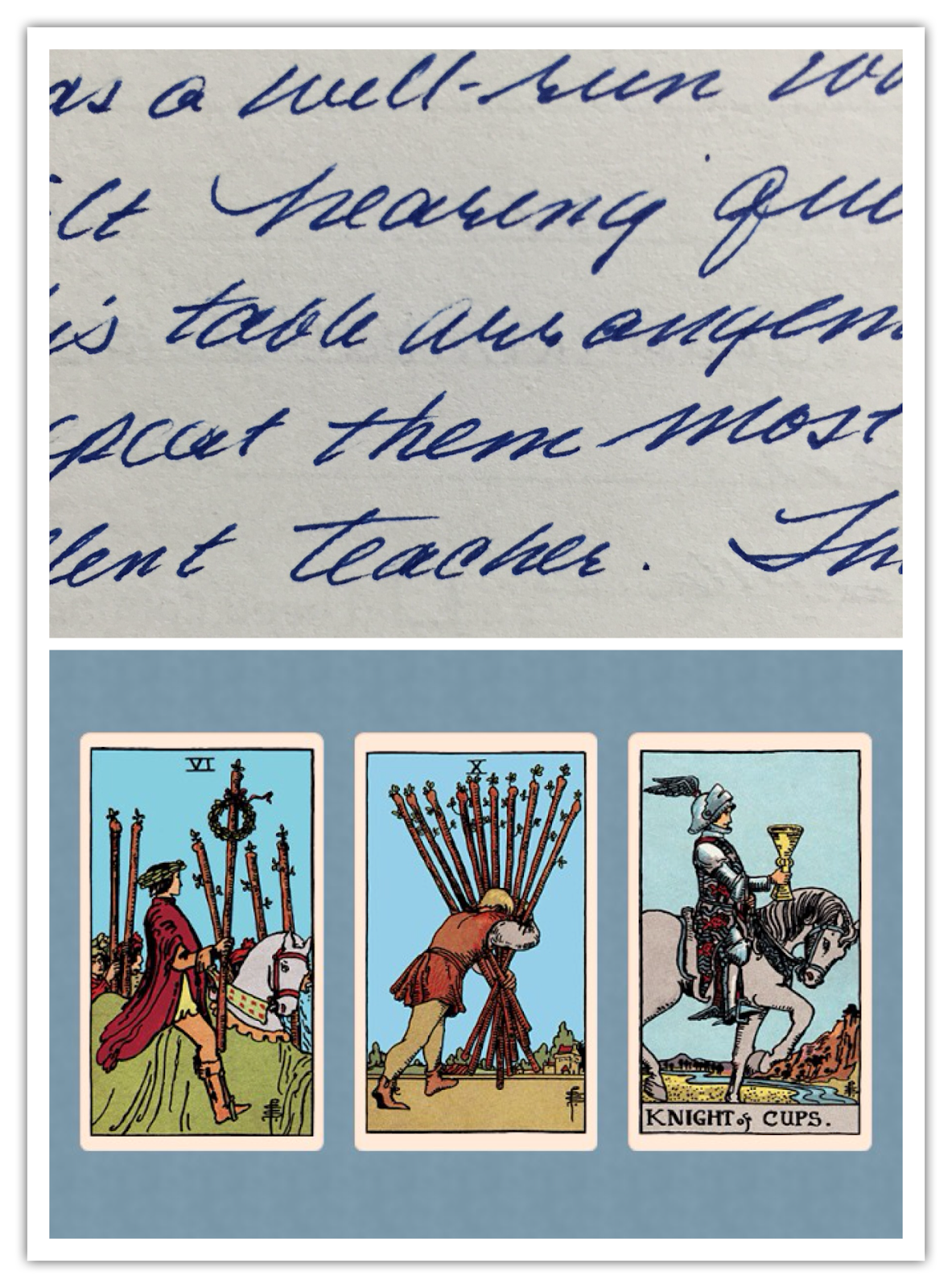

Photo Aug 24, 9 51 03 AM.png
We can see this spontaneity and forward movement in cards like the 6 of Wands, the 10 of Wands, and the Knight of Cups. In the 6 of Wands, the main character is swept up by the energy of the crowd. In the 10 of Wands, the character is so caught up in his work that he can’t see where he’s going. And the Knight of Cups follows his emotions wherever they lead him.

Thursday, April 14, 2016

tarot and your handwriting

This blog post was inspired by my discussion on Instagram with Jenna of Queen of Wands Tarot about how handwriting reflects tarot in many ways.

I received my certification in handwriting analysis from the KAROHS International School of Handwriting Analysis many, many years ago, long before the arrival of texting and other technology that's making handwriting obsolete. But what I learned about handwriting symbolism overlaps so many other symbolic systems, including tarot. In fact, I associate the suits with the four main handwriting types. You may not have any use for handwriting analysis but perhaps you'll learn more about the qualities of Wands, Swords, Cups and Pentacles by understanding the handwriting styles they reflect.


GARLANDS reflect the suit of Cups


The garland is a concave formation in the shape of a cup. Like an open hand, it represents someone with an open, generous and responsive nature. The garland writer is both emotional and expressive. They are also passive and non-competitive. They desire to avoid conflict and are highly adaptable. Their goal is communication and acceptance. They are all about sharing, exchanging, and cooperation. They are offering their cup to you and they want to receive and exchange cups with others. This is very easy to see in the symbolism of many of the Cups cards.


ARCADES reflect the suit of Pentacles


The arcade is a convex formation in the shape of an arch. It represents support and structure. Arcade writers are usually traditional, orderly, slow to change, and patient. The arch is a protective symbol. Likewise, people who write with this formation have a strong need to protect and serve. They also use the cup formation -- it's just an upside down cup. This means the arcade writer is emotional but they tend to control the expression of their emotions, preferring methodical thinking. If we look at the Rider-Waite tarot deck, we can see several examples of archways in the Pentacles cards. Even in the 6 of Pentacles, the pentacles are arranged in an arch over the characters.


THREADS reflect the suit of Wands


The thread is a curvy line. It's seen in handwriting that seems to slowly disintegrate or just wiggles across the page. People who write with a thread are curious and want to see and know everything. These are quick, creative thinkers who see the big picture but have little patience for the details. Often, threaded writing occurs as a result of speed. The mind is rushing along while the hand struggles to keep up, sacrificing legibility in the process. This type of writer can also be undisciplined and unpredictable, evading commitment, control and direction. Can you see threaded thinking in the Wands cards?


ANGLES reflect the suit of Swords


In handwriting, there are only two lines -- straight and curved. Out of the four handwriting types, the angle writer is the only one who chooses the straight line over the curve. To better understand angular writing, compare it to the flexibility of the curve. Straight lines are unbending and rigid, which reflects the nature of angle writers. The angle is associated with sharp mental acuity and also with assertiveness. Angle writers love to argue debate and refuse to compromise. They are often seen as cold and calculating. They make excellent strategists and, with their strong will and determination, they can succeed where others fail. This may give you more perspective on the Swords cards and the characters' motivation in these cards.


Here is handwriting expert Bart Baggett's video assessment of the extremely angular signature and handwriting of Donald Trump.


Tarot images are from The Classic 1910 Tarot app by The Fool's Dog. If you have an interest in handwriting analysis, I recommend Handwriting Analysis: The Complete Basic Book.

http://www.amazon.com/Handwriting-Analysis-Complete-Basic-Book/dp/087877050X/ref=sr_1_1?ie=UTF8&qid=1460415527&sr=8-1&keywords=handwriting+analysis+karen+amend